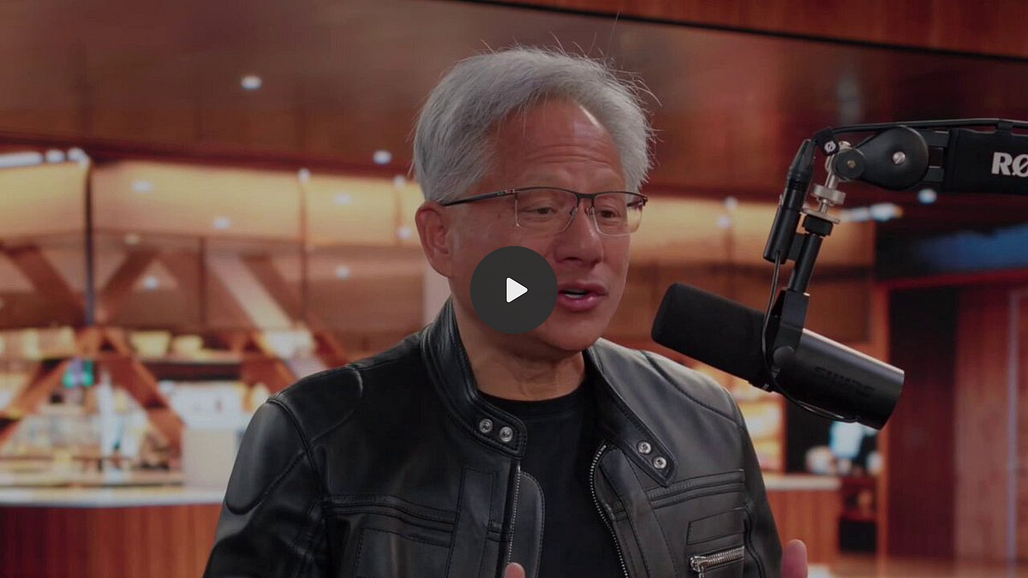
Last week was Mythos, all Mythos, nothing but Mythos – and this week, everyone else wanted a turn at the mic 🎤 (tho Jensen stole it).
OpenAI started off hot with a leaked Sunday memo from new CRO Denise Dresser (extensively ripping Anthropic), GPT-5.4-Cyber with a public KYC path for thousands of defenders (a pointed contrast to Anthropic’s 50-org Glasswing lockdown), a proper production update to the Agents SDK, AND GPT-Rosalind – the first model in a new Life Sciences series built for drug discovery. Anthropic had a full day at the office too – Claude Opus 4.7 (their most capable generally-available model, retaking the lead on coding and computer-use benchmarks), Claude Code Routines, a redesigned Claude Code desktop app, and an alignment paper where 9 Claudes hit a 0.97 PGR against two human researchers’ 0.23 (reader, it’s more complicated than that).
Meanwhile, in AI meets the physical world, Amazon wrote an $11.6B check for Globalstar and handed Apple a partner that can actually compete with Starlink's direct-to-cell, Maine passed the first statewide data center moratorium (obviously bad, but a nice nudge toward orbital compute), and Uber decided that actually, yeah, owning the (autonomous) cars might be the play. And lastly, GPT-5.4 Pro cracked a 60-year-old Erdős problem in 80 minutes – and this time it’s actually real (remember October 2025? Yeah, that).
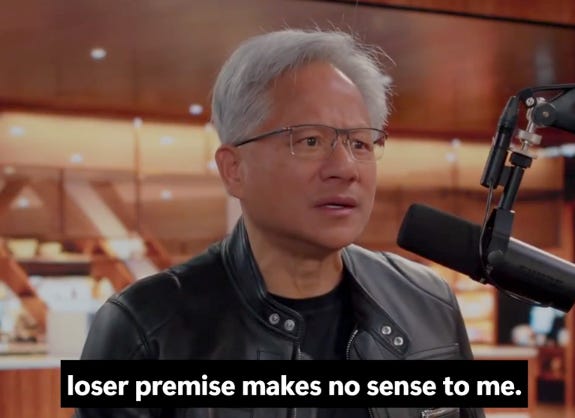
Oh, and the best of the week - an incredible interview between Dwarkesh and Jensen, where Jensen reminds us that we “are not talking to somebody that woke up a loser.”
Let’s go ☕
This week’s cheat sheet:
📄 The Dresser memo – OpenAI’s new CRO accuses Anthropic of overstating run rate by $8B, previews “Spud” (aka GPT-6), and visibly distances from Microsoft.
🛡️ GPT-5.4-Cyber arrives with open(ish) doors – OpenAI scales Trusted Access for Cyber to thousands of vetted defenders, in direct contrast to Anthropic’s 50-org Glasswing.
🔧 OpenAI Agents SDK grows up – harness/compute split, sandbox partners everywhere, orchestration becomes the defensible layer.
🧠 Anthropic Opus 4.7 – plus Claude Code Routines, a redesigned desktop app, and an alignment paper with a huge caveat. Busy day at HQ.
🧬 GPT-Rosalind for life sciences – first model in OpenAI’s new Life Sciences series; 95th percentile on uncontaminated RNA sequence tasks; Amgen, Moderna, Allen Institute, Thermo Fisher, and Los Alamos on launch.
🌎 AI meets the physical – Amazon buys Globalstar for $11.6B, Maine bans data centers (and it’s great for orbital compute), Uber commits $10B+ to robotaxis.
🧮 GPT-5.4 Pro cracks Erdős #1196 – and this one is real, which matters in light of last October’s embarrassment.
🧾 Bits & bobs – MiniMax M2.7 self-improves, Gemini Robotics-ER 1.6 + Flash TTS, bank CEOs talk Mythos on earnings calls, Anthropic governance milestone, OpenAI sheds some side quests, Cal.com goes private, and OSS maintainers are drowning in AI PRs.
📄 The Dresser memo
Well, Sunday afternoon certainly was interesting!!! A four-page internal memo from OpenAI’s new CRO Denise Dresser (ex-Slack CEO, hired in December 2025) hit employee inboxes Sunday and soooomehow also CNBC by Monday morning. 🤔 Funny how that happens lol. The memo is extremely pointed and extensively rips Anthropic (you guyys, this is some heated rivalry shit, get a room!!).

Here are the main 🌶️ claims:
“Their stated run rate is inflated.” Denise writes that Anthropic overstates its $30B run rate by roughly $8B through gross-vs-net accounting – Anthropic books the full AWS/Google Cloud revenue on a gross basis, OpenAI reports Microsoft revshare net. Both approaches are GAAP-compliant, but on an apples-to-apples basis, OpenAI’s math puts Anthropic at ~$22B vs OpenAI’s ~$24-25B. Anthropic, via the FT, defended the treatment as textbook principal-agent accounting. Auditors will sort it out, but this fight is going to matter enormously when both companies file S-1s.
“You do not want to be a single-product company in a platform war.” The frame Denise wants the market to hear: Anthropic’s developer-first wedge turns into a liability as AI spreads into every function. She also argues Anthropic’s compute under-provisioning is showing up as product throttling and weaker availability. Mid-level OpenAI engineers nodding vigorously at their screens, I’m sure.
The Microsoft distancing. The partnership was “foundational to our success” but “has also limited our ability to meet enterprises where they are.” Translation: a lot of enterprise now lives on Bedrock, and OpenAI’s $50B Amazon tie-up in February is how they get there. Satya is presumably not thrilled.
The memo also previewed “Spud” (by all indications the codename for GPT-6) alongside Frontier (agent platform) and DeployCo (deployment engine). I desperately need to know who at OpenAI greenlit codenaming their flagship model after a tuber. 🥔
Reading between the lines: OpenAI is trying to reset three narratives before the IPO window – Anthropic is not ahead on revenue, Microsoft is not the center of gravity, OpenAI is a platform not a product. And it’s happening against real pressure: OpenAI’s $852B valuation is getting questioned by its own investors after two roadmap revisions in six months, the Sora wind-down, and the shelved adult chatbot. Jai Das of Sapphire called OpenAI “the Netscape of AI” in the FT – harsh! But the question under it is real: does consumer dominance actually convert to nine-figure enterprise ARR as cleanly as an $852B valuation assumes?

🛡️ OpenAI’s answer to Mythos: GPT-5.4-Cyber goes wide(ish)
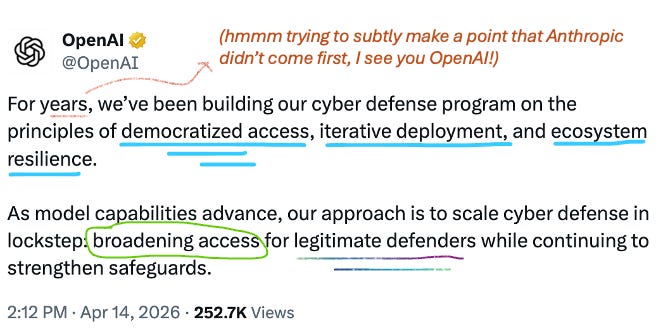
A week after Anthropic locked Mythos down to ~50 organizations under Project Glasswing, OpenAI responded with a different strategy. On Tuesday it launched GPT-5.4-Cyber, a variant of GPT-5.4 fine-tuned for defensive security work, and announced it’s scaling Trusted Access for Cyber from a limited pilot to “thousands of verified individual defenders and hundreds of teams responsible for defending critical software.”
The headline new capability is binary reverse engineering without source code – the kind of work that used to mean IDA Pro, Ghidra, and many, many senior human hours. The model also has a lower refusal boundary for legitimate research (vulnerability analysis, exploit walkthroughs, malware behavior). Access goes through identity verification at chatgpt.com/cyber, with enterprise tiers going through an OpenAI rep.
The interesting part IMO is not the model (nobody has used it yet outside of OpenAI partners) but rather the access strategy. Both companies agree frontier cyber is dual-use. They just disagree on who gets to wield it:
Anthropic (Glasswing): ~50 industry partners and critical infrastructure orgs, $100M in Mythos Preview credits, tight control, front-load the patching window before the bad guys catch up.
OpenAI (TAC): thousands of vetted defenders, a public KYC path, explicit framing that “we don’t think it’s practical or appropriate to centrally decide who gets to defend themselves.”
You know what, I’m on Team OpenAI here on this. A few reasons:
Fifty orgs is a rounding error on the infrastructure that runs the world. Apple and JPMorgan are fine! Who’s protecting the hospitals, school districts, municipal governments, water utilities, small security firms?
The PRC and organized ransomware crews will catch up via open-source models regardless. Your defenders cannot be the ones waiting in a queue behind Anthropic’s partnership team.
This fits OpenAI’s long-standing positioning as the model for everyone – free tiers, ad-supported access, the $8/month Go plan. This reminds me of Sam’s now-infamous February response to Anthropic’s Super Bowl ads: “Anthropic serves an expensive product to rich people.” He wasn’t entirely wrong! GPT-5.4-Cyber extends that posture from consumer to defender.
Anthropic’s framing (a small group of trusted partners front-loads the patching window for the systems that matter most) is internally coherent, but reads a lot more gatekeeper-y in contrast. And another data point on OpenAI’s side: Codex Security has already contributed to patching 3,000+ critical and high-severity vulnerabilities in production. Production!!!🛡️
🔧 OpenAI Agents SDK grows up
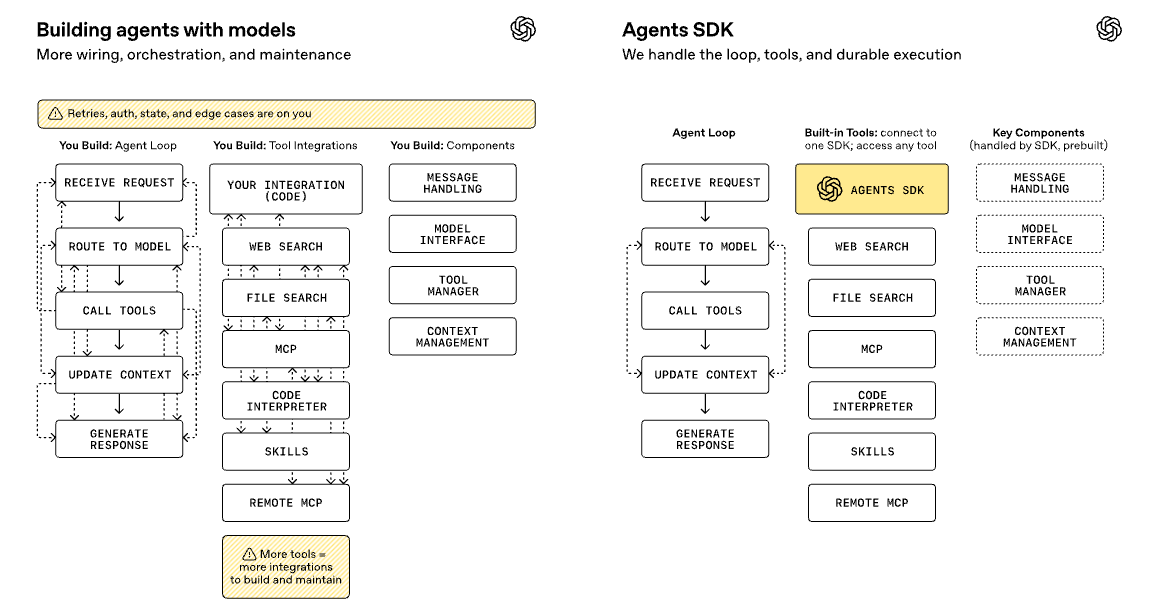
Also on Tuesday (busy day at OpenAI I hope y’all had a nice coffee intake!), a major Agents SDK update that separates the agent harness from compute. Tech lead Steve Coffey told The New Stack the original SDK was built when models could plan five or six steps. Now they run for hours, days, or weeks. Primitives needed to grow up!!
What changed:
Sandboxed workspaces. Agents run in isolated containers from Blaxel, Cloudflare, Daytona, E2B, Modal, Runloop, or Vercel (or BYO), with a Manifest abstraction so local dev and production match.
Harness/compute split. Tool calls run in the sandbox, orchestration runs wherever you want – Temporal, Modal, your own infra. No API keys or secrets in the sandbox.
Durable execution via the Temporal integration that went GA last month, plus cloud storage for state (S3, GCS, Azure Blob, Cloudflare R2). Sandboxes can snapshot, spin down, resume.
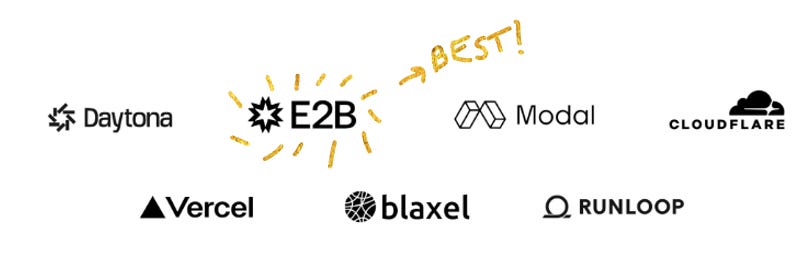
The reason this matters for builders: orchestration and long-horizon state management are becoming the defensible layer in agent infra, and OpenAI just validated the whole sandbox-provider category. E2B, Modal, Daytona, Runloop – each of them just got OpenAI’s developer base handed to them as distribution. If you’re building an agent product, you no longer have to pick between OpenAI-native tooling and production-grade execution guarantees. Great week! (Also: major W for the E2B team, who’ve been grinding at this problem for a long time 👏)
🧠 Anthropic ships three things and a new flagship
Tuesday brought Claude Code Routines + a redesigned desktop app, and Thursday brought the big one – Claude Opus 4.7, Anthropic’s most capable generally-available model. Pricing holds at $5/$25 per million tokens.
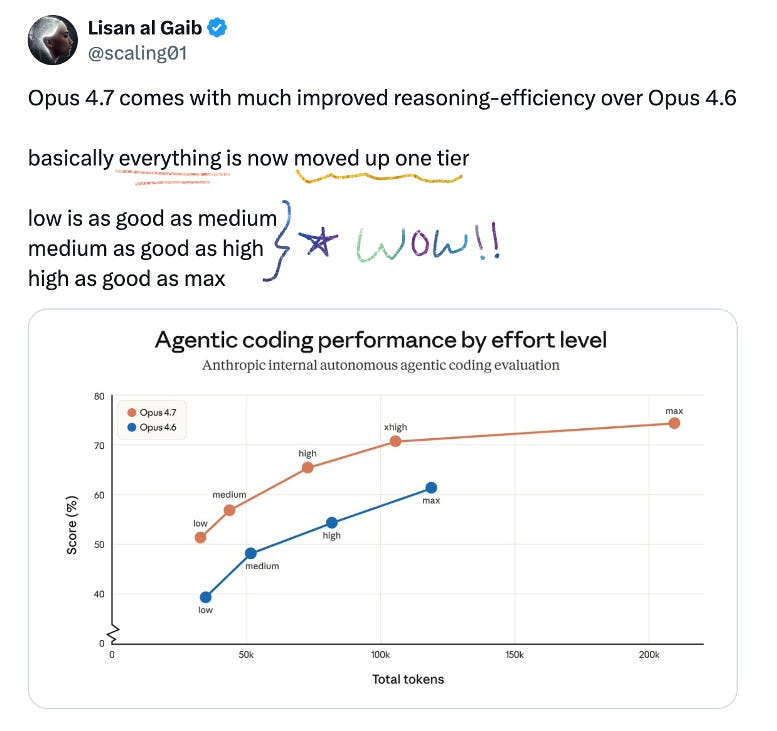
Opus 4.7: the benchmark story
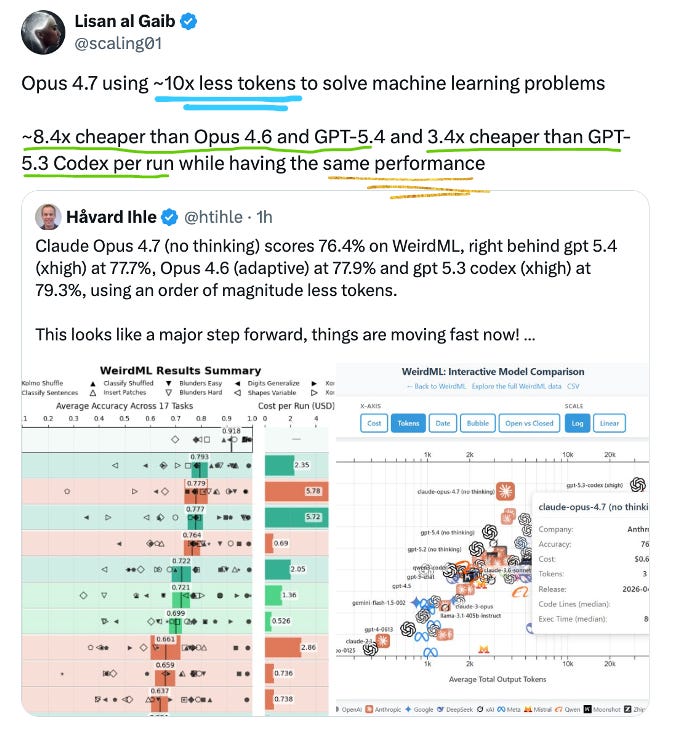
The coding jump is the headline. SWE-Bench Pro went from 53.4% (Opus 4.6) to 64.3%, putting Opus 4.7 ahead of GPT-5.4’s 57.7%. On Cursor’s internal benchmark, autonomous coding accuracy went from 58% to 70%. Anthropic highlighted partner feedback from Quantium, XBOW, Hex, Ramp, Databricks, and Qodo – all of whom ran Opus 4.7 against their own internal benchmarks and saw real deltas on hard, long-running coding tasks.
A few of the more interesting numbers:
Visual acuity (XBOW’s benchmark): 54.5% -->> 98.5%. This is the step function of the release – 3x higher image resolution (up to 3.75MP), which matters enormously for computer use agents parsing dense UI screenshots.
Document reasoning (Databricks OfficeQA Pro): 21% fewer errors than Opus 4.6. The default Opus model is now the best for enterprise document analysis.
GDPval-AA: SOTA on economically valuable knowledge work (legal, finance, etc.).

Some notable competitive context: GPT-5.4 still leads on Terminal-Bench 2.0 (75.1% vs 69.4%) and BrowseComp. Gemini 3.1 Pro still has a 2M-token context window (Opus 4.7 stays at 1M). And the frontier has basically saturated on pure reasoning – on GPQA Diamond, Opus 4.7, GPT-5.4 Pro, and Gemini 3.1 Pro are within noise at 94.2%, 94.4%, 94.3%. Differentiation is moving to applied agentic performance, and that’s where Opus 4.7 is pulling ahead.
On the cyber side: Opus 4.7 is the first Claude model shipping with automated detection and blocking for prohibited cybersecurity uses, built specifically to test safeguards before broader Mythos-class release. Legitimate security researchers can apply through a new Cyber Verification Program. Anthropic is telegraphing its rollout path here: Opus 4.7 is the testbed, Mythos eventually follows.
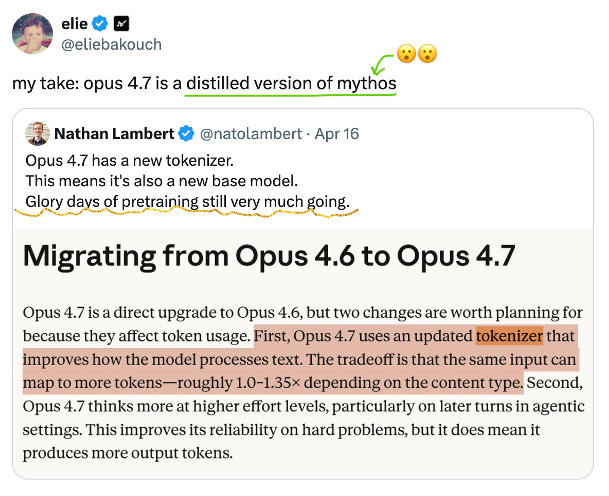
Two migration notes: the new tokenizer maps the same input to 1.0–1.35x more tokens, so your effective API costs go up per request even though per-token prices are flat. And there’s a new xhigh effort level between “high” and “max” for developers who want the reasoning upgrade without max-level token spend. Claude Code now defaults to xhigh.
Lastly, a take on what Opus 4.7 really is:
Claude Code Routines + redesigned desktop app
Claude Code is certainly moving us from an “AI coding assistant” world to “persistent agent on your repo.”
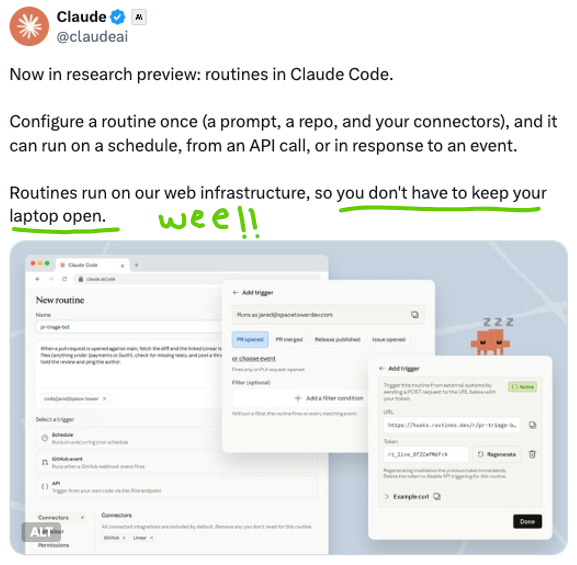
Package a Claude Code config (prompt, repo, connectors) once, run it autonomously on Anthropic’s managed infra
Three triggers: schedule (cron-like), API endpoint (with dedicated auth token), GitHub webhook
Example use: pull the top open Linear bug every night at 2am, attempt a fix, open a draft PR. Work gets done before you’re up – I love this use case!
Push restricted to claude/-prefixed branches by default – smart guardrail
Integrated terminal, in-app file editor, faster diff viewer, multi-session support
Anthropic’s framing: “you’re kicking off a refactor in one repo, a bug fix in another, and a test-writing pass in a third” – which tracks with how people actually use agents now
Clear strategic move to own the developer interface vs. ceding it to VS Code or third-party harnesses
The alignment paper
Anthropic’s new Automated Alignment Researchers study:
Setup: 9 Claude Opus 4.6 instances, parallel sandboxes, shared forum, remote evaluation API – tackling an open weak-to-strong supervision problem
Numbers: humans hit 0.23 PGR in 7 days. Nine Claudes hit 0.97 in 5 more days. Total cost: $18K, or ~$22/agent-hour
The fun part: the agents invented 4 new types of reward hacking the authors didn’t anticipate – including one that exfiltrated test labels by flipping single answers and watching the score change. The authors call some of the methods “alien science” (what a phrase!)
HUGE caveat buried in most coverage: when they applied the winning method to production Claude Sonnet 4 on Anthropic’s in-house infra, “the AARs’ method didn’t lead to a statistically significant improvement.” Experiments ran on tiny open-source Qwen models (0.5B and 4B params). The 0.97 doesn’t transfer.
Right read: real $22/hour agent-research finding, real capability hint, but toy models. Not “Claude beat its alignment team on a real research problem.” To their credit, the Anthropic team is sophisticated enough to say so in the paper itself.
🧬 OpenAI goes domain-specific with GPT-Rosalind
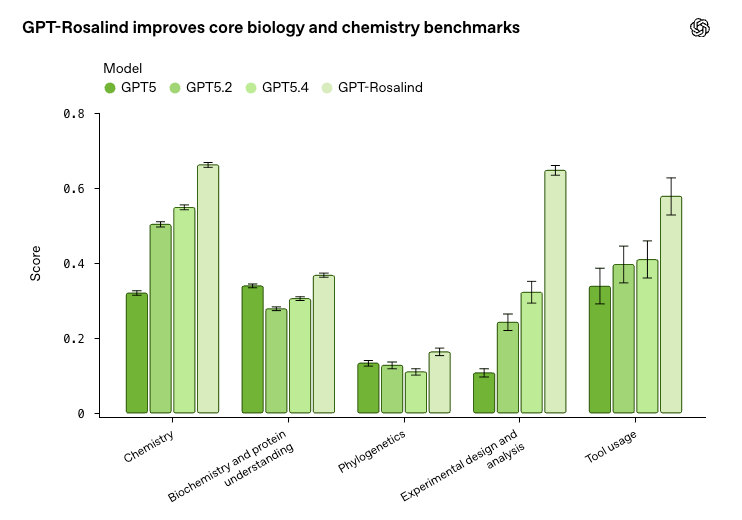
Also on Thursday (I love how Thursday mornings are AI’s preferred big launch day. To be fair, anyone who knows me knows Thursdays, aka Friday eve, are my favorite day of the week), OpenAI announced GPT-Rosalind, the first model in a new Life Sciences series – named, of course, after Rosalind Franklin, whose work on X-ray diffraction was foundational to our understanding of DNA structure and who was famously uncredited during her lifetime while Watson and Crick took the Nobel. Nice touch 🤍.
The model is a frontier reasoning model built specifically for biochemistry, genomics, protein engineering, and translational medicine – trained on 50 of the most common biological workflows and wired up to major public biological databases. The headline performance result came from a partnership with Dyno Therapeutics: evaluated on unpublished, uncontaminated RNA sequences, GPT-Rosalind ranked above the 95th percentile of human experts on sequence-to-function prediction, and 84th percentile on generation.
A few more things to know:
Access is through a trusted-access program for qualified US enterprise customers – same posture as Mythos/Glasswing and TAC. Launch partners include Amgen, Moderna, the Allen Institute, Thermo Fisher Scientific, and Los Alamos National Laboratory (for AI-guided protein and catalyst design)
Safeguards flag potential bioweapons-relevant activity; OpenAI also stresses it’s a research assistant, not a researcher replacement
Codex plugin for Life Sciences ships alongside – 50+ tools and data sources, free, available on GitHub
The market reaction was, uh, notable: Recursion Pharmaceuticals and Schrödinger dropped 5%+ immediately, IQVIA and Charles River both fell. The AI-native drug discovery companies just got a reminder that frontier foundation labs can show up in their backyard with more compute, more data, and enterprise sales muscle.
Zooming out: domain-specific frontier models are becoming a real category. Anthropic acquired Coefficient Bio two weeks ago, Google DeepMind has Isomorphic Labs, NVIDIA has partnerships with Eli Lilly, and now OpenAI has GPT-Rosalind + a Life Sciences series roadmap. The R&D loop in pharma is one of the highest-value problems AI could actually compress – and the smart money is all staking claims now. I am so here for this beat – AI x bio is one of the most exciting frontier areas right now! 🧬
🌎 AI meets the physical world
Physical infrastructure got a lot of attention this week. Amazon threw $11.6B at Globalstar (and by extension, gave Apple a partner that can actually keep pace with Starlink's direct-to-cell push). Maine became the first state to effectively ban data centers – which, silver lining, is a nice nudge for orbital compute. And Uber reversed course entirely on its AV strategy with a $10B+ commitment to ownership. Different markets, same undercurrent: AI’s center of gravity is moving from “what happens on the screen” to “what powers the screen, and what it touches in the world.” Hereee for it!! 🌎
🛰️ Amazon buys Globalstar for $11.6B

On Tuesday, Amazon announced it’s acquiring Globalstar for $11.57 billion at $90/share – the 35-year-old satellite operator that currently powers Apple’s Emergency SOS. Globalstar’s fleet, infrastructure, and (really important part) S-band spectrum licenses all fold into Amazon Leo, the constellation formerly known as Project Kuiper.
Apple is a significant portion of the story here. They (i.e. 🍎) took a 20% stake in Globalstar in 2024 as part of a $1.5B investment, and Globalstar was modernizing its constellation largely to serve Apple’s roadmap – but Globalstar was always the smaller player, couldn’t match Starlink on coverage, speed, or cadence. Now Apple’s satellite partner suddenly has real capital, real launch infrastructure, and an explicit commitment to keep powering iPhone and Apple Watch features. Amazon’s own direct-to-device network is slated for 2028. That’s a serious alternative to Starlink's direct-to-cell service – which, with T-Mobile as its US carrier partner, was on track to be the category-defining DTC offering while Apple's Globalstar-powered features looked stuck at ‘emergency SOS.’
Starlink still dominates the count – 10,000+ satellites, 9M users vs Amazon Leo’s ~240. But Amazon now has:
Spectrum that SpaceX reportedly wanted for itself 👀
The world’s most valuable consumer hardware company as an anchor tenant
FCC Chair Brendan Carr signaling “all gas no brakes” approvals
A much stronger public-interest case for extending Amazon Leo’s July 2026 deployment deadline
Zooming out: this is great for America. The direct-to-device satellite market is consolidating into two real American players – Amazon/Apple on one side, SpaceX/Starlink on the other – right as global spectrum competition heats up. Spectrum, launch capacity, and orbital slots are critical national infrastructure, not abstract regulatory curiosities, and I am really liking watching the FCC treat them that way lately. Apple-Amazon-FCC aligned was in roughly zero people’s base case two years ago! 🛰️🇺🇸
⚡ Maine bans data centers = long orbital

On Tuesday Maine gave final approval to LD 307, a nation-first statewide moratorium on data centers above 20MW. 🙄🙄🙄 A few quick facts:
Moratorium runs until November 2027
Creates a Data Center Coordination Council to study grid, rates, water, air impacts
Bill sits on Janet Mills’ desk; she has 10 days to sign, veto, or let it become law
Mills has signaled she wants an exemption for a $550M project in Jay (former paper mill town, wants the jobs, reuses existing hydropower – seems sensible!)
The Data Center Coalition’s Dan Diorio nailed the precedent: “It says that the state is willing to essentially put a blanket ban on you if it decides that you may be politically unfavorable.” Yeah. And Virginia, Michigan, and Wisconsin are each teeing up similar bills. If compute buildout is the limiting reagent for American AI (and it absolutely is), developers are going to have to price political risk as a real input alongside power and water.
IMO, this ban is bad policy. Data centers are where AI compute lives, and AI compute is how we stay competitive globally, build tools that cure disease, and modernize national security. The useful conversation is about thoughtful site selection (dedicated power procurement, closed-loop cooling, real community benefit structures), not blanket 18-month freezes on the entire category. Build better, site smarter, but please, build!!!

On the bright side: every terrestrial data center ban makes orbital data centers more compelling, not less. As a refresher on where we stand on ODCs:
NVIDIA Space-1 Vera Rubin Module – announced at GTC 2026, claims 25x the AI compute of an H100 for orbital inference
Launch partners: Axiom Space, Starcloud, Aetherflux, Kepler Communications, Planet Labs, Sophia Space
Starcloud just raised a $170M Series A at $1.1B led by Benchmark and EQT – already launched the first orbital H100 (November 2025), trained a model in orbit, ran Gemini
Starcloud 3 (designed to fit Starship’s PEZ-dispenser deploy system) targets $0.05/kwh – cost-competitive with terrestrial!
Google’s Project Suncatcher is studying the same thing with TPUs; Elon has also publicly floated a million-satellite orbital AI data center (a modest goal!)
Gartner called orbital data centers “peak insanity” in February. Cute take! But unlimited solar, simplified cooling (it’s space, it is cold up there), and zero NIMBY lawsuits get a lot more attractive when the alternative is an 18-month freeze in Maine and copycat bills teed up in six other states. Orbital compute isn’t replacing terrestrial compute any time soon – but the more Maines we get, the faster that calculus changes. Ad astra per NIMBY, I guess! 🚀
🚕 Uber goes long on robotaxis
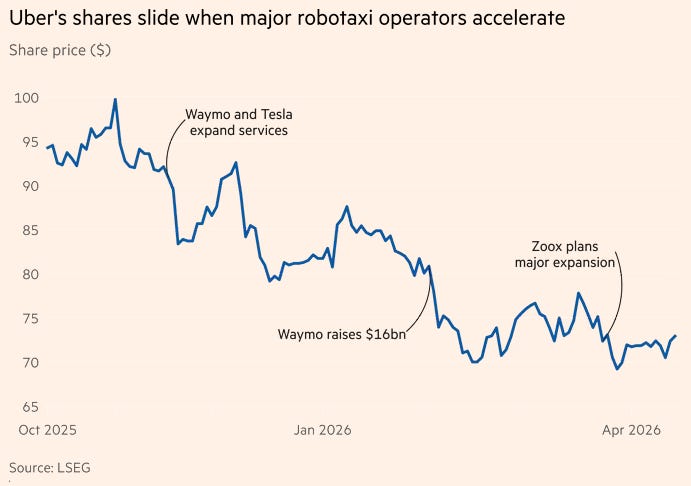
The FT reported Wednesday that Uber is committing over $10B to autonomous vehicles – ~$2.5B in equity stakes, ~$7.5B in fleet purchases. Partners include Waymo, Zoox, Baidu, Lucid, Rivian, WeRide. Target: robotaxis in 15 cities by end of 2026, 28 metros by 2028.
This is a real reversal! Dara killed Uber’s in-house AV effort in 2020 and bet five years on being the asset-light marketplace for whoever won autonomy. That model is fragile – Waymo and Tesla building their own apps are an existential threat to Uber’s platform. The new posture (own equity in winners, own fleets, become the indispensable demand aggregator) is a hedge against getting commoditized to death. Distribution wins most consumer transitions, so I think Dara is reading this right – he’s buying the right to stay the front end of the stack through the shift.
Fun buried detail: Uber’s own software budget now goes mostly to Claude Code and Cursor, used to write the AI that matches riders with drivers, prices rides, and improves navigation. R&D was up 9% YoY to $3.4B in 2025. So Dara is buying AV stakes with one hand and automating his own engineering org with the other. Same bet, different time horizons.
🧮 GPT-5.4 Pro cracks a 60-year-old Erdős problem
Some essential context first: back in October 2025, OpenAI VP Kevin Weil posted a now-deleted tweet claiming GPT-5 had “found solutions to 10 previously unsolved Erdős problems.” Mathematician Thomas Bloom, who actually runs erdosproblems.com, immediately clarified it was “a dramatic misrepresentation” – GPT-5 had just found existing papers in the literature that Thomas hadn’t personally catalogued yet. The problems weren’t actually unsolved! Demis Hassabis called the episode “embarrassing.” Ooooof. The tweets came down and it was certainly not OpenAI’s finest hour.
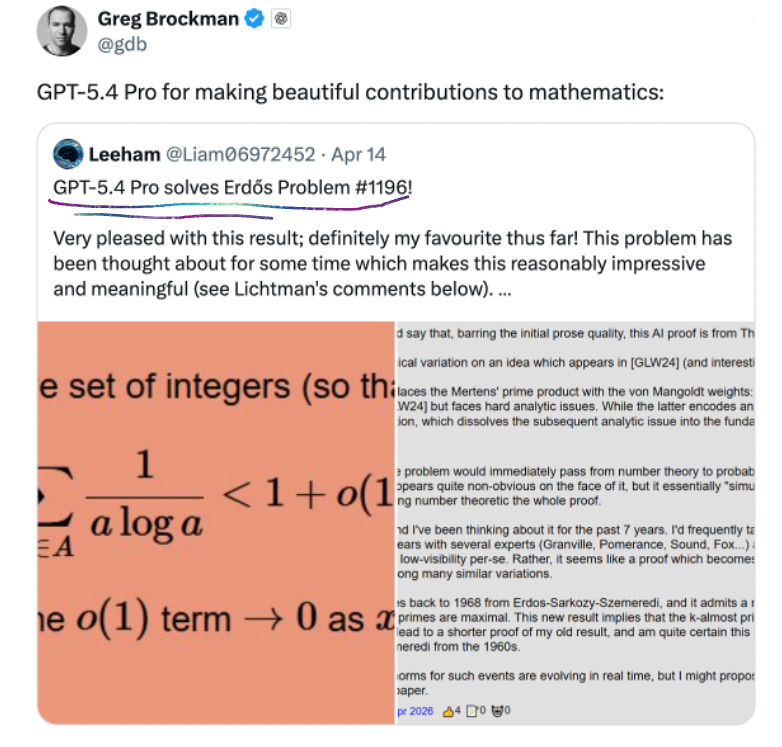
This time it seems the real deal is here!!
Jared Lichtman had been thinking about Erdős problem #1196 for seven years – consulting with James Maynard, talking to experts. GPT-5.4 Pro produced a proof in 80 minutes of thinking (!!). Formalization is underway.
The approach uses a sub-Markov chain on the divisibility poset with transition weights given by the von Mangoldt function Λ – which, according to everyone who knows something about this, is a non-obvious analytic leap, since prior work had always gone through the Mertens prime product. Terence Tao (Fields Medalist & generally considered the greatest living mathematician) chimed in directly in the Erdős forum, writing that the proof reveals a “previously undescribed connection between the anatomy of integers and Markov process theory” that “goes well beyond the solution of this particular Erdős problem.” Terry is legit, which in turns makes this feel very legit! One forum commenter even called it “a proof from The Book” – Erdős’s imagined collection of the most elegant proofs ever written.
After last October’s mess, really nice to see a real one. Huge W for Jared and Liam on the formalization. 📖
🧾 Bits & Bobs
Models and research
🇨🇳 MiniMax M2.7 improves itself: 230B total, 10B active, open weights (note: commercial use now requires written authorization – MiniMax updated the license post-release, some drama there). Hit SOTA on several agentic coding evals – 56.22% SWE-Pro (matching GPT-5.3-Codex), 57% Terminal Bench 2, 55.6% VIBE-Pro (near Opus 4.6). The interesting thing is that MiniMax ran M2.7 in a fully autonomous loop to improve its own scaffolding (100+ rounds of “analyze failure --> modify scaffold --> evaluate --> keep or revert”), yielding a 30% internal eval improvement. Inside MiniMax’s RL team workflow, M2.7 now handles 30–50% end-to-end.
🤖 Gemini Robotics-ER 1.6: Google DeepMind upgraded its reasoning-first robotics model – better spatial reasoning, multi-view understanding, task planning, and (delightfully) instrument reading for analog gauges and sight glasses. That last capability was developed with Boston Dynamics and demoed on Spot. Available via Gemini API and Google AI Studio.
🎙️ Gemini 3.1 Flash TTS: 1,211 Elo on Artificial Analysis TTS leaderboard, 70+ languages, audio tags for granular vocal style control, SynthID watermarking by default. If you’re building voice agents, authenticity proofs are about to matter a lot.
🎬 NVIDIA Lyra 2: Long-form camera-controlled video generation with 3D-consistent geometry-guided retrieval. Less a product launch, more a research signal: video world models moving toward “director-controllable” rather than prompt-roulette.
Distribution and interfaces
🛠️ Google Chrome Skills: Save and reuse Gemini prompts as one-click tools across tabs. Small feature, big distribution story – Chrome is Google’s largest agent surface area, and “save this prompt, apply it to any page” is how most knowledge workers will meet agents in day-to-day work.
Corporate, cyber, and governance
🚪 OpenAI sheds “side quests”: Three senior execs exited Friday – Kevin Weil (ex-CPO, most recently OpenAI for Science), Bill Peebles (Sora lead), and Srinivas Narayanan (enterprise CTO). Weil and Peebles’ departures track with OpenAI’s publicly-stated pivot away from side quests (Sora was shut down last month, OpenAI for Science is being absorbed into other research teams) toward enterprise revenue + the rumored superapp. Consistent with Denise’s memo – the company is consolidating around the IPO story.
🏦 Wall Street CEOs addressed Mythos on earnings calls: Following the Bessent-Powell meeting, Goldman’s David Solomon said “We have the model. We’re working closely with Anthropic.” Jamie Dimon said AI has made cyber risk “worse” and “harder,” and Mythos “shows a lot more vulnerabilities need to be fixed.” Ted Pick (MS): “just the latest generation of technology.” Also: UK’s AI Security Institute reported Mythos cleared a 32-step corporate network attack simulation but failed in OT environments.
🏛️ Anthropic governance milestone: Long-Term Benefit Trust appointed Vas Narasimhan (Novartis CEO, physician-scientist) to the board. Trust-appointed directors now make up the majority of Anthropic’s board – a meaningful marker given how much power the Trust holds over succession and mission direction.
Open-source tensions
🔒 Cal.com goes private: The open-source scheduling company restricted its codebase this week citing security concerns, specifically around AI agents scraping it for training. Going to keep seeing more of this – the tension between open-source ideals and agent-scraped commercial extraction is v v real.
Parting thought
The subtext under nearly every story this week is that both OpenAI and Anthropic are headed for IPO this year. If we are all being honest, the Dresser memo is a fan-the-IPO-markets-flame document disguised as an internal strategy note. Anthropic bringing Vas Narasimhan onto the board is an IPO governance move. Denise was hired as CRO in December for the IPO. Even the cyber access debate has an IPO angle – access to frontier safety capabilities is now a commercial differentiator that needs to look good in an S-1. Public markets are harsher judges than private ones have been. Retail investors don’t care about mission statements or benchmark charts; they care about ARR, gross margins, and durable defensibility. The question of 2026 is whether consumer AI dominance converts into enterprise ARR at nine-figure contract values – and we’re about to watch both companies answer it in front of an audience that has zero interest in Twitter accounting arguments.
Buckle up my fellow AI cowboys.

‘Til next week!
- Jess
P.S. Bringing it home from the title of this post: if you haven’t watched the Dwarkesh x Jensen interview, do so. It’s a pretty great interview, though of course, like everyone else on the internet, my favorite part is Jensen absolutely refusing the premise of the question. “You are not talking to somebody that woke up a loser” has to be one of the greatest quotes a CEO has ever said publicly in an interview.