
🇺🇸 The American Dream 🇺🇸
My personal story, and joining a16z American Dynamism

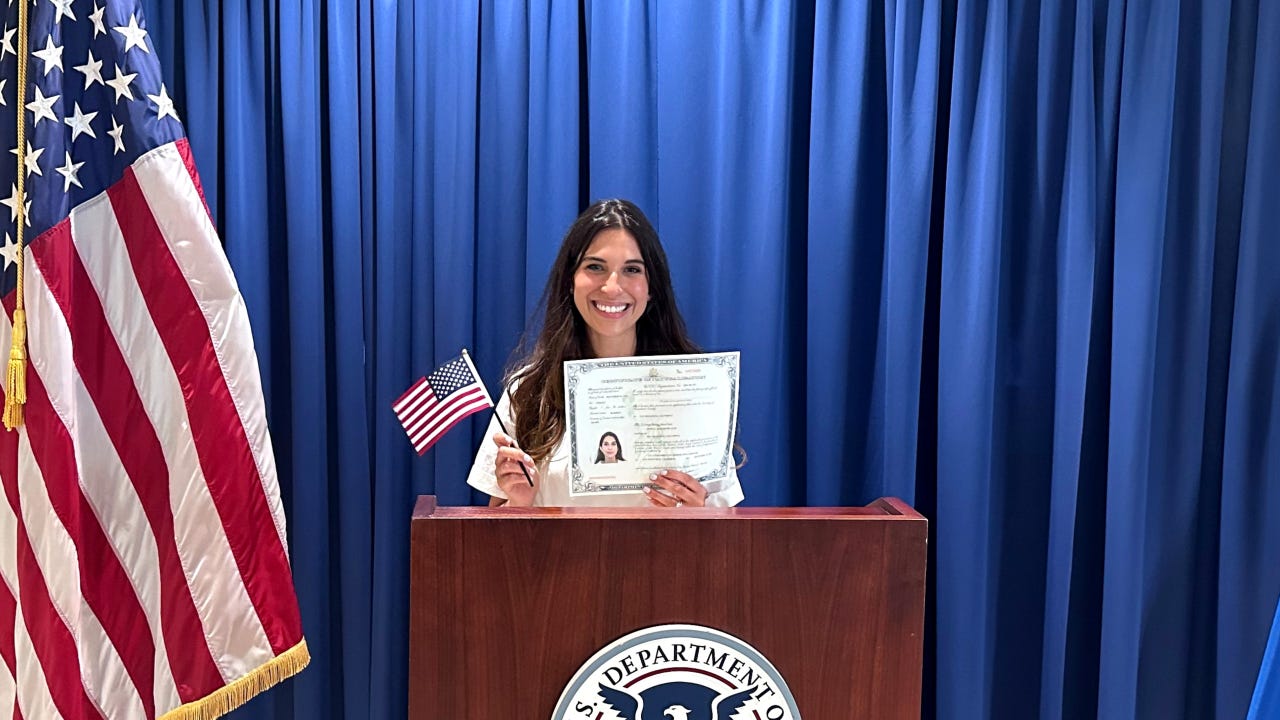
Today’s newsletter is a bit (read: very) different than my usual. I wanted to share some news with you all, and also talk about what the blog will look like in the future. I have been floored by the support as I’ve written every week and have had so much fun in this corner of the web.
As many of you know, I’m a venture capitalist and have always focused on investing in technical products. What you may not know is my journey to getting here – and by here I mean both technology, but also the United States. I’m sharing below the essay I shared on both LinkedIn and X today announcing that I’m joining a16z as a Partner on the American Dynamism team. I’ll be investing in founders building in the national interest: aerospace, defense, public safety, education, housing, critical infrastructure, industrials, and manufacturing.
What that means for this newsletter: it will likely look different moving forward! Bear with me as I get started on my new role, I will figure out a new cadence for writing and you will also likely see a lot more news & writing around deep tech & all things American Dynamism as well. As always, send me DMs, messages, with any of your feedback on what you’d be interested in reading more. This community is so important to me and this is just the beginning! 🚀
Without further ado, here is my story:
Today, I’m joining Andreessen Horowitz as a Partner on the American Dynamism team. The why of that, for me, is inseparable from where I came from – and the where I came from is something I’ve kept mostly to myself. I’d like to tell it now.
I was born and raised in Brazil. This much you may already know. I love my country of origin deeply - its spirit and warmth, its faith, the particular genius its people have for gratitude and for joy. And yet I will say what I have come to believe over many years away from it: there is no concept of a Brazilian dream – and I believe the same is true everywhere. There is only the American dream. It was the dream I reached for, and it is the reason I am writing this today.
My hometown of Salvador has its own kind of beauty, grittier than the ocean that gets all the credit. The people there have a spirit I have never found anywhere else: warm, faithful, fun-loving, grateful for what they have even when it isn’t much. The home I grew up in was its own version of that: beautiful in places, broken in others.
I had an older brother named Pedro, but he died when I was five. My father grieved Pedro the rest of his life, and the grief took him; he passed five years ago. My mother raised me mostly on her own, in a country where women did not have the same opportunities as men. The story, from here, perhaps is not surprising: money was scarce, and we fell into debt. There were nights with not enough food on the table. There was homework done by candlelight because the electricity had been cut off. There was the fear, often, that I might not be able to keep my home. Of material things, I did not have much.
What I had was curiosity, a thirst for knowledge, a love for books, a positive mindset. But intelligence and enthusiasm only take you so far in a country with near-zero social mobility. The path through it, like the path through most things in Brazil, runs on connections and money. Money brings money. Being smart, on its own, does not.
By the time I was a teenager, I understood there was no future for me in Brazil. No one told girls like me to dream big – to imagine becoming something different from what we were born into. The message, delivered in a hundred different ways, was always the same: put your dreams away. Aim lower. Know your place. The violence was constant too; over the years I lived through several bouts of it, from an actual knife injury to a gun held to my head.
I started looking elsewhere. I spent nights in internet cafes searching for a way out – for information I would not otherwise have had access to, about a world I had only heard rumors of. That is how I learned, sometime around two in the morning, that the best American universities would give a full scholarship to a girl from Brazil who couldn’t pay. I applied. I got into Yale. I came to America for college, and I never left.
My love for this country is not the love of someone who was born to it. It is the love of someone who chose it, and who knows what it is to live without it.
America saved me. I mean that quite literally. It is hard to describe the feeling of safety to someone who has never not felt so. It has been fourteen years since I left my country, and not one day goes by where I don’t go for a walk at night, just because I can. It is my private ritual, so that I never forget the great blessing it is to walk alone on a deserted street, at whatever hour, and not feel fear.
It is not just safety. It is a culture of daring, a celebration of trying something new, even if it fails, and the knowledge that hard work bears fruit. It is meritocracy, and freedom. It is the right to complain about the government, ad nauseam, to disagree out loud, to be wrong in public, with nothing to fear.
I do believe that America is still “the city upon a hill,” a beacon of hope to those who come here and live here alike, those in pursuit of the American dream. I carry a debt of gratitude to this country that took me in, and saved my life, asking for very little in turn.
What we have here, we keep only by defending it.
Democracy is not a given. Goodness is not inevitable. Technological progress is not inevitable. There are versions of our world that fall lawless to crime, apologetic to terrorism, deferential to regimes that would dismantle the very ideals that allow this essay to be written.
The proof is already in the numbers.
A decade ago, the United States led in 60 of the 64 most critical technologies. Today, China leads in 57. We have allowed our manufacturing base to be hollowed out, our shipyards to atrophy, our energy grid to age past the point of safe operation, our defense procurement to ossify into a system that takes longer to field a new fighter than it took to win the Second World War. None of this is irreversible. All of it is urgent.
There are brave Americans who serve to protect what we have. They deserve more than our respect – they deserve to be protected too. Hope is not a strategy. Freedom is not free.
I knew early that this was the fight I wanted to be in.
I came to technology through Palantir, where I worked as a Forward Deployed Engineer on Palantir Gotham, the company’s national security platform. Palantir was where I learned, viscerally, what software in service of the country could actually do; that an engineer at a desk in Palo Alto could meaningfully change the outcome of a counterterrorism operation, a humanitarian response, a fraud investigation. It was also where I learned that the most regulated, slow-moving, mission-critical sectors of the country – the ones startups had been told for decades not to bother with – were exactly where the most consequential work could be done.
When American technologists have the audacity to take on sectors the rest of the world has written off as too hard, too regulated, too entrenched, too expensive – they win, and the country wins with them. I have seen it happen. I know it is true.
It was technology that gave me access to the life I have now. If it had not been for the internet, I would not be where I am today.
I am sure there is another young girl somewhere in Brazil who will one day say the same about AI.
I believe deeply that the United States is the right country to be training these models, building these reactors, launching these rockets, machining these parts. I will sleep in peace at night knowing that the frontier carries an American spirit – of freedom, of open-mindedness, of meritocracy, of striving, of placing infinite value on a single human life.
But the work cannot stop at legal copilots and accounting agents. We need AI applied to energy abundance, to materials science, to cancer. We need to rebuild our manufacturing base, modernize our defense industrial complex, harden our critical infrastructure, secure our supply chains. We need to reach further into space – humanity’s long-term survival depends on it, and the resources beyond this rock exceed our wildest imagination. These are not nice-to-haves. They are the work of the country.
American Dynamism backs founders building in the national interest – defense, aerospace, energy, manufacturing, public safety, and the physical infrastructure of the country. It is the practice that backed Anduril when most of Silicon Valley wouldn’t touch defense, Hadrian when reshoring precision manufacturing was unfashionable, Saronic and Castelion and Apex when the conventional wisdom said hardware was too hard of a business for venture capital. The thesis was articulated by Katherine Boyle in 2022, and its goal is plainly stated: to make America “the country people want to be from, to immigrate to, and to build a life, career or company in.”
Yes.
I will dedicate the rest of my life to seeing the American dream fulfilled – for the next generation here, and for the next generation of immigrants who will need this country the way I did.
I may not be a soldier. But I can fight.
I may not be a natural-born citizen. But I am an American.
I am profoundly grateful to David Ulevitch, Erin Price-Wright, Katherine Boyle, and the entire Andreessen Horowitz team for the trust. And I am grateful, always, to the United States – for the walks at night, for the second chances, for the American dream that turned out to be real. 🇺🇸
There is work to do. I cannot wait to get started.
—Jess
💪💪💪
Massive congratulations and wish you all the best, Jess. They are lucky to have you.